Despairingly Seeking A Craft and Poetics of Hope

Share
Despairingly Seeking A Craft and Poetics of Hope
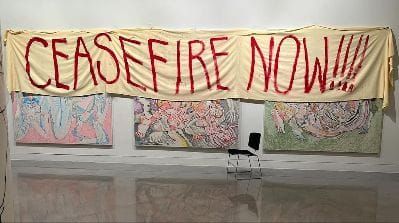
Image: Artists alter, deface their own work at YBCA to protest Gaza silence and decry censorship

Originally published Spring 2024

Try to praise the mutilated world.
Remember June's long days,
and wild strawberries, drops of rosé wine.
The nettles that methodically overgrow
the abandoned homesteads of exiles.
You must praise the mutilated world.- Adam 
Zagajewski
Journey Notes ~ Up Next: One on one & Review in Reckoning ~ Writing Hope in Memoir, Poetry, Fiction ~ Writing Experiments: Hope ~ Places to Submit ~ Who Am I, What Is This?
Happy Spring!

Hope is on my mind a lot these days: how in this moment of so much loss, I see people continuing to organize, to donate, and to stand up up using every means they have.
I started wondering what does hope look like in writing?
I have examples below in Creative Nonfiction (Memoir), Poetry, and Speculative Fiction, and further reading. 
Let me know what's bringing you hope lately, and what you're reading. Next month (ish), we'll be talking about my favorite hopeful queer genre: Eco-Horror. 
Happy Writing, Keep in touch!
xoxoxo Syr. 
Up Next:
My Review of Green Fuse Burning in Reckoning
One Spot Opening Up In March: 10% Off For You! 

My review of Tiffany Morris' magnificent swampcore book Green Fuse Burning is out in Reckoning Press this week.

Reckoning is a home for "creative writing on environmental justice." Their book reviews editor is wonderful, and I had a fantastic time writing for them. Consider querying them!  


MORE HERE

ONE SPOT LEFT FOR ONE-ON-ONE WORK
 
I love working with artists and writers one-on-one. I'm a producer-for-hire, developmental editor, literary auntie, coach, writing room captain, art top, and imaginary friend. 
I have ONE spot opening up in March, and then I'm booked for the month! You can read more here
If you'd like to know more about this, you can sign up for virtual tea, which is free.

Mention this newsletter, I'll give you 10% off our session. 
SCHEDULE VIRTUAL TEA!
Writing Hope, 3 Ways

So here's my stupid case for the stupid emotion otherwise known as hope; writing it, reading it, drawing it, feeling it. Which is also, I suppose, a stupid case for the continuation of art. 

Before I go on about hope, I want to set some caveats.


Caveat One: Hope is not a magical endless resource we owe anyone, Even in Writing 
I want to acknowledge that hope, or art, is not a place it’s particularly easy to live in now. When Anne Boyer resigned from the New York Times, she wrote in her resignation: 

“If this resignation leaves a hole in the news the size of poetry, then that is the true shape of the present.”
- Anne Boyer


And if that’s how you are feeling right now, that’s a valid response. Sometimes, gentleness, spaciousness, and time to grieve are needed. Art may be a practice of self liberation, but art and hope, these are gifts, and gifts are not something you owe.  
Image: Artists alter, deface their own work at YBCA to protest Gaza silence and decry censorship
Caveat Two: Avoiding False Hope 

 Lauren Berlant 
coined the term "cruel optimism," in her book, which Johann Hari simplified in Stolen Focus

“Cruel optimism is when you take a really big problem with deep causes in our culture … and you offer, in an upbeat language, a simplistic, individual solution." 

Cruel optimism says that we can get there if we work harder. It says that everyone will be happy at the prom, even if wildfires are raging. It doesn’t work as an artistic process. I suspect it doesn’t work in books and art either. It’s half assed. That was a Candide joke just for you, Jen. 

But just for the sake of argument, I want to look for a process, practice, and poetics of hope that holds the both/and:

[Writing] isn't just thinking about the world out there. It's also thinking about how that world might be—a particularly important exercise for those who are oppressed, because if they're going to change the world we live in, they—and all of us—have to be able to think about a world that works differently.
- Samuel R. Delany
So here are three places I've found that both/and of hope, 
and ideas for writing from them in Memoir/CNF, Poetry, and Fiction. 
1. Hope in Memoir: Letters, Truth, and Losing in Letters Cecilia Gentili's Faltas 
On Feb 6, 2024, we lost transgender activist, actor, author, and mother to many, Cecilia Gentili. Cecilia gifted us a memoir from LittlePuss Press, “Letters to Everyone In My Hometown Who Isn’t My Rapist.”

What I did not expect was to read it and be filled with hope. This book shows me that you can stare unflinchingly as the very worst, and still hold love, hope, joy.

I find a heart of this book about five pages into her letter to her mom: 


This is the hard part, Mami. This is the whole reason I am writing this letter. I can't hide it anymore. LIke vomit, it needs to come out of me. I know if I had ever attempted this face to face, you would have found a way to run away from it. This is the benefit of a letter. I just get to tell you what I need... I need to say this, but the reason I need to say it so much is because it is only once i have said it that I can also say: I understand.

Letters allow for tangents, for asides, for the full truth, and for vulerability. In an interview with Them, Cecilia redefines power, winning and loss:  


"But it’s time for me to stop fighting. Because I am still here. I am talking to you. I am telling my story in a fucking book. And I feel joyous about it. There’s a lot of beauty in being a loser. I’m such a loser. I love being a loser. Losing took me years. But in losing that fight,
I fucking won."

- Cecilia Gentili, Interview in 
Them. 
Cecilia was celebrated by over a thousand queer and trans people marching into St. Peter’s Cathedral in New York. It’s a triumph. And you can hear sound from it here. You can buy your own copy of Faltas here.
2. Hope in Poetry: Kink, Pleasure, Rage, and Grief in Jubi Arriola-Headley's Bound 

Jubi Arriola-Headley (he/him) is "a Black homoflexible poet, storyteller, first-generation United Statesian," who writes poems that engage in equal measure pleasure, kink, rage, grief, vulnerability, and love.

What I most love about his work is the way he allows nptj pleasure and the politics/vulnerability that surround both the Black and queer experiences. He writes; 


        the exercise of pleasure as
revolution. The incantatory vapors it
raises, they steady us. We breathe, deep,
for all those what couldn’t.


He writes a poem to God, in which he gossips with them, and is still mad at them. 
So…who is
the ‘you’ and the ‘we’ in this fiction? God asks, resting
Their chin in Their hands, drinking me in, the way one sits
with any queerness. (God will slip into vernacular at will.)


Hope to me comes through in allowing all experiences to be here at once. In gossiping with God, in allowing pleasure and despair to be tainted with one another. You can read more of Jubi's poems here, and buy your copy of Bound here


"The poet Willie Perdomo told me once in a workshop “write the hard poem.”
And I take that shit as gospel.

Whether you read it as angry or heartbreaking or gutting or funny or silly, every poem I write is high-stakes, at least in my own mind.

- Jubi Arriola-Headley, interview in 
Electric Lit 
3. Hope in Fiction: Monsters, Eco-Horror, and Mud in Tiffany Morris' Green Fuse Burning

Tiffany Morris is an L’nu’skw (Mi’kmaw) speculative fiction writer and poet from Nova Scotia.

Her book 
Green Fuse Burning is a swampcore eco-horror novel about an artist who is grieving climate change and loss, and encounters something in the swamp: Lichen Woman, who is part monster, part swamp, all nature. What I love most is that through grieving what is vulnerable, Morris gives us something SO EXTRA, it can't be killed.

Check out this description of Lichen Woman, one of my favorite in all writing last year:


Rita pushed herself backward through mud and reeds, away from the woman of her vision, instinct taking over in responding as if her fire were real. The woman’s form was revealed with new clarity as sunlight broke in a halo behind her head. Dripping sap and mycelium held the cursed being together in orange layers of rotted frill, a woman and not-woman wrapped in the skin of the swamp. The sweet and sour too-wet stench of decay emanated from the creature, conjuring in Rita a mix of revulsion and hunger. Pulsating pustules lined the woman’s torso, as brilliant as shining jewels as they burst from beneath folds of lichen. Rita’s head swam at the overpowering presence of her, the dangerous beauty of this otherworldly entity. The woman was the triumph of life over death, the maggot rot of decomposition cycled into new existence. She was victory over her father’s last struggling breath. The rabbit. The fox. The bludgeoned roadkill blazing on hot summer roadsides. A mouse’s dripping twitch in a stray cat’s mouth. The woman’s existence was like all those dead things had crawled out from death’s hidden corners, eyes gleaming as they breathed once again.

Tiffany Morris takes climate change sadness and transforms it. The too-muchness, the hyperabundance, the loving indulgence of what can’t be killed. I never knew how much hope and joy could be found in the monstrous. But why not create a monster, or engage in the swamps? 


“Wetlands are devalued for the same reason that death and trauma are ignored . . .

we do not see the importance of holding space for pain or holding the literal space of the swamp, even though both are about life itself. Even though they help other areas of life thrive.”

- Tiffany Morris, Green Fuse Burning 

My friend, the writer and artist Nancy Au, said to me once there is always a poem.

Not that you should always write a poem, but there is always a poem. She said, if all else fails: 
“What is the view from the bathroom floor?”

From the metaphorical bathroom floor, after whatever got me there, crying, sick, despairing, I see cool white tiles, a window with a tiny slice of blue, or stars, and sometimes the moon. I can see an illuminated place between the stars where we could all go beyond this moment. If I’m very lucky, I can help bring it closer, at least to me. At least long enough to get myself to a place where I can go out and protest, or call my representatives, or keep on writing/dancing/loving being human, or vote. 

(not my window, BTW)
What are your favorite hopeful texts of the last year? Where are you finding hope, in writing, art, and life? Will you let me know? 

A kraken and a sky full of constellations. Text reads: Star Maps & Sea Monsters
WRITING EXPERIMENT 

1.  Write a letter. Consider Cecilia Gentili's lesson on losing. 
2. Write the the big poem. 
3. Write the thing that can't be killed. 
4. Write from: 
“What is the view from bathroom floor?"
Find the beauty that can only be seen from this moment. 
OPPORTUNITIES

1. James Jones First Novel Fellowship for a novel-in-progress is due March 15th. 

2.  Reckoning is open for writing on climate justice.  

3. F(r)iction is open to submissions!!!  

4. VONA, workshop for BIPOC writers, is open for applications until March 15th.  

5. Creative Capital grant for artists across media and genres is open NOW until April 4th. 
Happy Spring. May we all keep hope in action. 
Photos: thousands attending ceasefire rally in San Francisco, March 4. Photo by Kron4. 
"What is This And Who Are You?" / Can I Get A Present?
 
Hey! I'm Syr (they/them). Thanks for saying hi! Here's a present for you! It's a writing session organizer! 

You are getting this because a) you signed up, thank you!; b) you're an artist/writer in my community or you've enjoyed my work and said it was ok to add you; c) you were subscribed to The Escapery newsletter, or have taken a workshop with me, or have worked with me one-on-one. Welcome. Be welcome to unsubscribe at any time. 

Who Am I? I'm a writer/storyteller/artist, Art Top, and Imaginary Friend. I used to work for the cats, now I'm a producer for hire. I specialize in helping artists, especially writers, find and keep their practice, finish their books, establish their careers, and expand the possibilities of their form. You can read my testimonials here.

You can check out my upcoming workshops here.

Think you might like to work with me? Sign up for a 30 minute Free Virtual Tea below!